Unlocking new maps: what changes between lakes
As you progress in Seaplane Dispatcher, new maps open up with different lakes, islands and docks. This explainer covers what to look for and how to settle into a fresh layout.
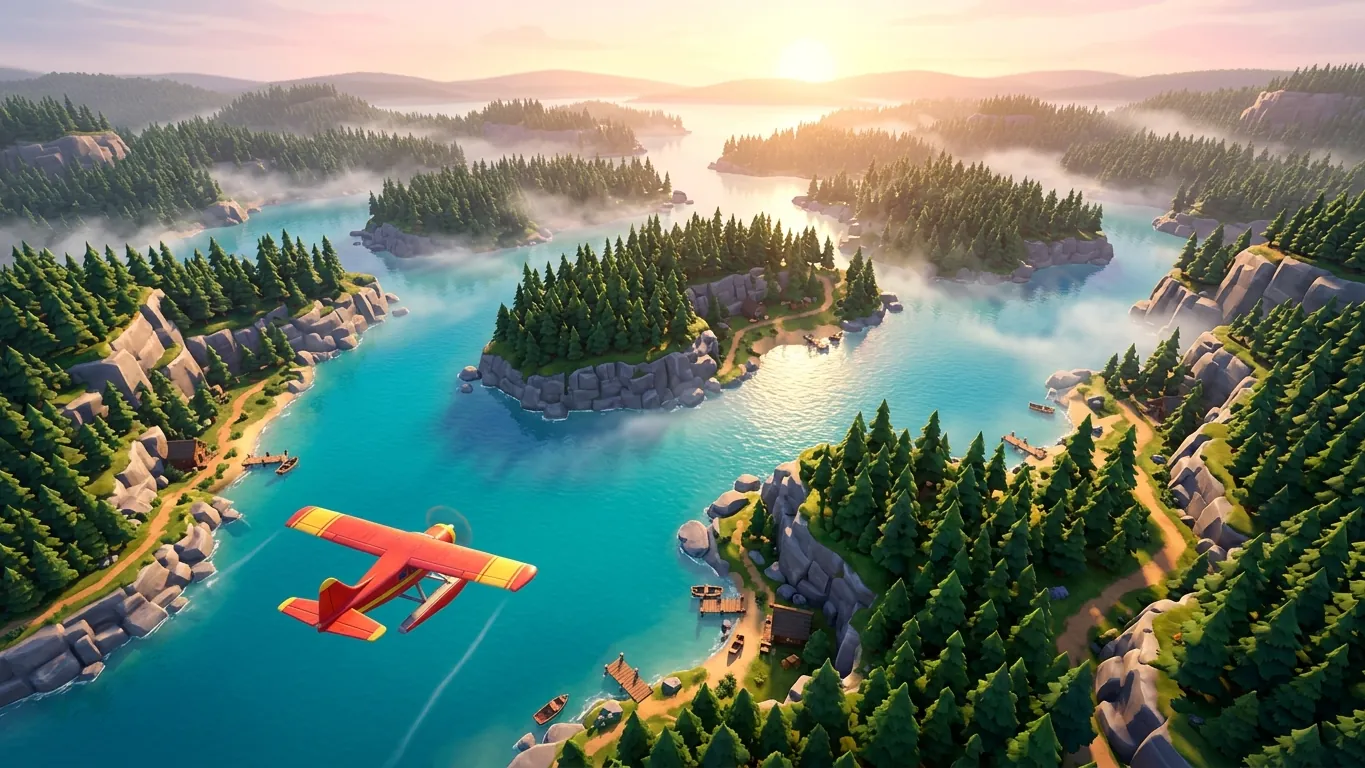
How new maps open up
Seaplane Dispatcher unlocks new maps as you progress through its levels. Each map is another part of the fictional Canadian lake district, with its own arrangement of water, islands and docks.
The exact requirements for each unlock are shown in the game, so check the map screen if you are unsure what to do next. In general, steady progress through the earlier levels is what opens the way forward.
Unlocking a new map is a good moment to slow down. Skills from earlier maps carry over, but a different layout can make familiar habits feel awkward at first.
What tends to differ between maps
The rules stay the same from map to map. Planes still follow your routes, collisions still end the level and docks still need to be assigned. What changes is the space you work with.
Some layouts have broad open lakes with plenty of room to turn. Others are crossed by narrow channels between wooded islands, which forces routes closer together. Docks may be grouped in one harbour or spread along several shorelines.
These differences change which strategies work. Lanes that were easy on an open map can be tricky where islands block the way. A dock split that suited one map may leave another with an overloaded harbour.
Your first run on a new map
Use this approach to get comfortable with an unfamiliar layout.
- 01
Look at the whole map
Before the first plane arrives, note where the open water, channels and docks are.
- 02
Pick rough lanes
Decide which corridors planes from each edge will use.
- 03
Spread the docks
Plan to use harbours on different sides rather than relying on one.
- 04
Treat it as practice
Expect early attempts to be learning runs, not record attempts.
New maps and the later challenges
Fast planes, dense fog and urgent flights interact with each map differently. On a map with narrow channels, fog over a channel can be especially tricky, because routes there are already close together. On an open map, fast planes have more room, but they also cover long distances quickly.
When a challenge feels harder on a new map, ask whether the layout is the reason. Often the fix is not a new technique but a small adjustment, such as using a different lane or moving your reserve dock to another shoreline.
Going back to earlier maps
Unlocking a new map does not make the earlier ones less useful. Returning to a familiar layout is a good way to practise a specific skill, such as routing fast planes or handling fog, without the added difficulty of learning new terrain.
Earlier maps are also a pleasant change of pace. After a demanding session on a crowded layout, a calmer map can be a relaxing way to enjoy the turquoise lakes and small animated planes that give the game its character.
Thinking of the maps as a set, rather than a ladder, makes the whole game feel more varied and helps your skills grow evenly.
Related articles
 Why short levels suit an air traffic puzzle
An opinion piece on Seaplane Dispatcher's short levels: why brief sessions suit an attention puzzle, where they work well and where they fall short.
Read more
 Seaplane Dispatcher basics: your first shift
New to Seaplane Dispatcher? Learn the core loop of drawing routes, landing seaplanes and assigning docks, plus habits that prevent early collisions.
Read more
 Drawing clean flight paths over the lakes
Learn how to draw seaplane routes in Seaplane Dispatcher that keep planes apart: path shape, lanes, crossing angles and when to redraw mid-flight.
Read more