Managing fast seaplanes without collisions
Fast planes cover the map quicker than the rest and throw off your sense of timing. These tips explain how to route them safely alongside slower traffic.
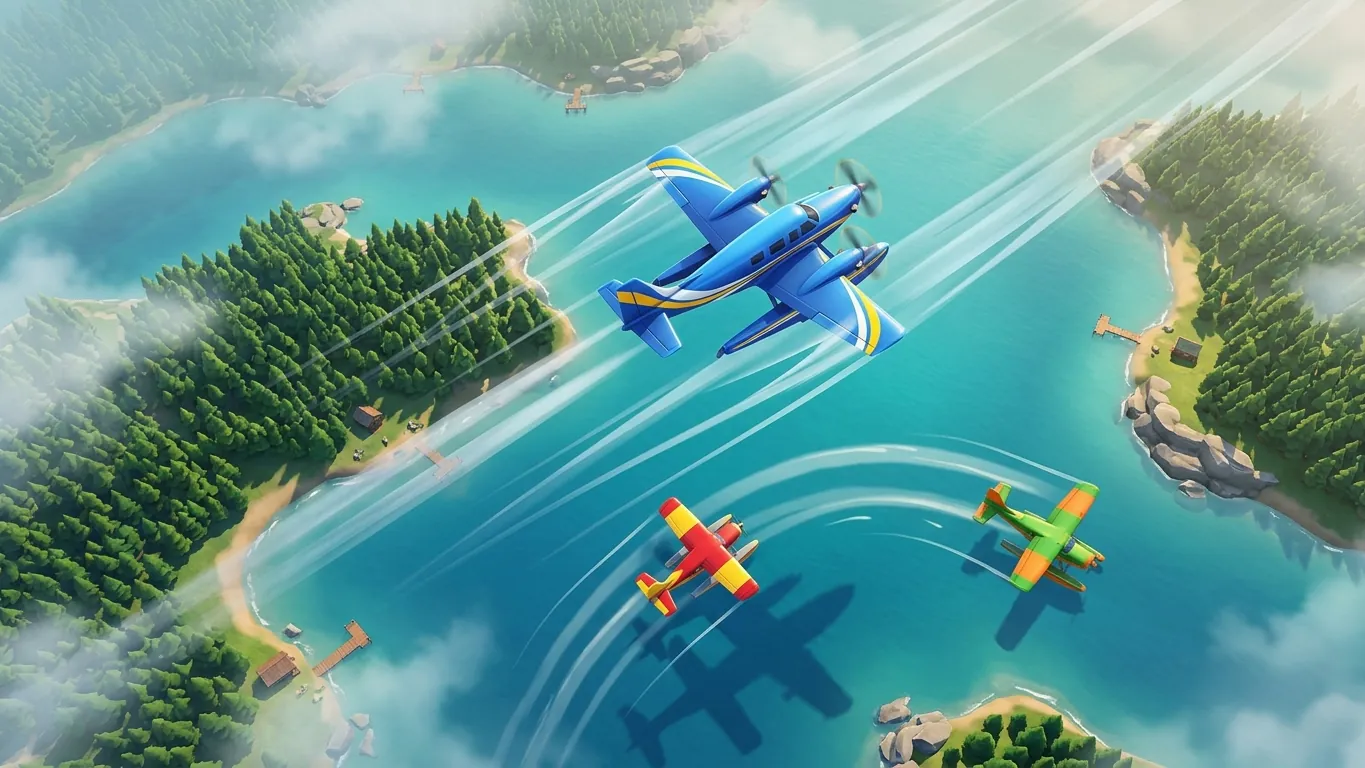
How fast planes change the timing
Seaplane Dispatcher eventually introduces planes that move noticeably faster than the ones you started with. They follow routes the same way, but they reach crossings, shorelines and docks much sooner.
This matters because so much of route planning is about timing. With slower planes, you get used to a certain rhythm: draw a line, watch the plane, adjust if needed. A fast plane compresses that rhythm. A crossing that looked safe a moment ago can become a conflict because the fast plane arrives before the slow one has cleared it.
The first step is simply to recognise fast planes as they enter and treat them as a separate category in your head.
Give fast planes the outer lanes
A practical approach is to keep fast planes away from the busiest parts of the map. Route them along the outer edges of the lake district, where there is more open water and fewer crossings.
If the slower planes use the central lakes, the fast ones can loop around them without interfering. The extra distance costs little time, because fast planes cover it quickly.
This also makes fast planes easier to track. When they always use the same outer corridors, you know where to look for them, and you are less likely to lose one among slower traffic.

Route fast planes first
When several planes need attention at once, deal with the fast one first. It will reach trouble sooner than anything else on the map, so it has the least margin for delay.
Give it a clear route and a free dock, then return to the slower planes. They usually have time to wait a moment for your attention.
It also helps to assign fast planes to docks with simple approaches. A dock behind a tight island bend leaves little room for error at high speed. A dock on open shoreline lets a fast plane come straight in without crowding neighbouring docks.
A routine for mixed-speed traffic
Use this routine when fast and slow planes share the sky.
- 01
Spot the fast plane
As soon as a fast plane enters, find it and note its direction.
- 02
Route it immediately
Draw a clean route along an outer lane before handling anything else.
- 03
Check the crossings
Look for any slow plane whose route crosses the fast plane's path and move one of them.
- 04
Return to slower traffic
Once the fast plane is safe, go back to planning routes for the others.
When fast planes meet fog or urgent flights
Later levels may combine fast planes with fog or urgent flights. These moments feel hectic, but the same principles apply.
In fog, keep fast planes out of the covered area whenever you can. A fast plane hidden in mist is the hardest object on the map to keep track of.
When a fast plane and an urgent flight appear at the same time, consider which one is closer to a conflict. Often the fast plane needs a route first simply because it will reach other traffic sooner, while the urgent flight needs a reserved dock and a clear approach.
Practise these combinations in short sessions. Over time, the separate habits blend into a single, steady way of reading the map.
Related articles
 Urgent flights: prioritizing under pressure
Learn how to handle urgent flights in Seaplane Dispatcher: clear the approach, choose which plane waits and stay calm when several arrive at once.
Read more
 Chasing high scores in short levels
Tips for improving your records in Seaplane Dispatcher: build consistency, learn each map's rhythm and use short levels for focused practice.
Read more
 Unlocking new maps: what changes between lakes
An explainer on new maps in Seaplane Dispatcher: how progress opens fresh lake layouts, what tends to differ and how to approach your first run.
Read more